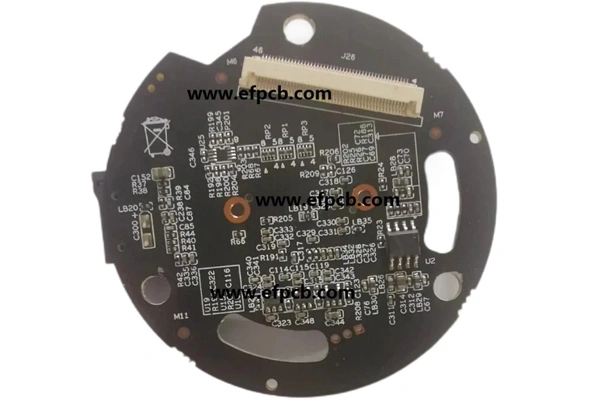
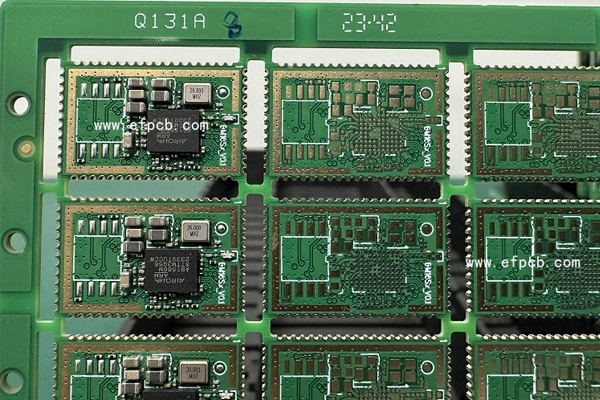
A Guide for the Printed Circuits Assembly of Surveillance Camera Motherboards
Reliable vision systems are designed and manufactured from the board up This guide details proven best practices for printed circuits assembly in a surveillance camera motherboard, while providing readers with an overview of our capabilities to increase yields, thermal reliability, and low noise performance. And here’s a practical guide – from raw materials and component strategies to process control and regulation – that translates to stable images and long life. Principle Design Consideration for Image Fidelity Clean electrical signals and thermal stability are critical to high-quality imaging. Reduces noise and drift, and guarantees long-term accuracy.
1. Power integrity first: Employ low ripple PM IC, LC filters, and a power distribution network (PDN) with low impedance over the sensor and ISP rails. Put decoupling close to BGA balls, and achieve effective ESL/ESR by using mixed value ceramics. Low noise layout: Analog, digital and RF grounds are isolated, but come back together at one point star at the power entry level. MIPI CSI and other high-speed lines to be routed as length matched differential pairs with controlled impedance.
2. Thermal Management: Couple image sensor and SoC hotspots to a copper coin or heat spreader; add via arrays under power stages. Warping? Do not to worry, our boards have 2-3 OZ global copper thickness or 2-3 OZ local copper pours for equalizing these hot spots.
Printed Circuits Assembly Product Features that Enhance Reliability
Our platform is designed to enhance first pass yield and field reliability in the printed circuits assembly of a surveillance camera motherboard. IPC Class 3 quality build: Fabrication and assembly are to IPC-A-610 Class 3 workmanship for mission critical devices, providing superior reliability and cleanliness of solder joints. Automotive grade passives: The default bill of materials (BOM) includes high quality capacitors and resistors which are designed to minimize drift in wide-temperature applications.
- Sensory-centric stack-up: Typical 8-10 layer stack with a dedicated analog ground plane and High-Speed Reference plane separated to mitigate crosstalk to the image pipeline.
- Speed assurance: MIPI lanes are tested at 2.5–4.5 Gbps/lane with insertion-loss budgeting and S-parameter analyses. Edge-rate control reduces EMI without excessive damping.
- Precision timing: Low-jitter XO/TCXO packages next to ISP domain; PLL power isolated with ferrites + LDOs stabilize frame timing.
- Conformal coating options: Acrylic and Parylene processes available for salt‑spray and humidity resilience in outdoor housings.
What Matters in the Assembly Process Controls of Printed Circuits Assembly
Doing the same thing over and over is as god as the design. Our
printed circuit board assembly line for surveillance camera motherboard is designed based on measurable stability.
Solder paste control: 3D SPI with CpK >1.33 on volume and area; Type 4/5 paste for 0.4 mm pitch BGA and 0201 passives.
- Reflow profiling: 8–10 zone convection with nitrogen; per-SKU thermal recipes validated through embedded thermocouples on live boards.
- X-ray and AOI: 100% inline AXI for hidden joints, and multi-angle AOI. SPC dashboards monitor defect Pareto and initiate closed-loop stencil or placement corrections.
- Cleanliness, Ionics: Tested post-reflow ionic contamination to be ≤1.0 μg, NaCl-eq/cm2 to ensure no risk of leakage at sensor end.
- ESD and Handling: Sensor and ISP nodes protected with ANSI/ESD S20 compliant floors, packaging and personnel controls.
- Materials and Environmental Endurance: The durability and cost depend on the materials base and finish you use in your printed circuits assembly of your surveillance camera motherboard. Substrates: FR4 Tg 170+ for thermal headroom; low loss laminate available for long MIPI runs in PTZ models. Surface finish: ENIG for fine pitch stability; ENEPIG on gold wire bonded sensor modules. Temperature cycles: Boards are qualified at −40 to +85 °C for >1000 thermal cycles, and solder joint reliability is established using daisy-chain test vehicles.
Data‑Backed Quality and Compliance for Printed Circuits Assembly
There are independent standards to define what “good” looks like and can be monitored and enforced in the printed circuits assembly of a surveillance camera motherboard.
Stable image quality starts with disciplined power integrity, noise isolation, and thermal engineering in the printed circuits assembly of a surveillance camera motherboard.
Our build aligns to IPC Class 3 workmanship and JEDEC moisture controls, with data‑driven SPC across SPI, reflow, and AXI, improving first‑pass yield and field reliability.
Material choices, high‑speed validation, and protective finishes make the boards resilient in outdoor and high‑EMI settings.
Rapid DFM feedback of Printed Circuits Assembly
48 hour design reviews alert you to solder joint risk, tombstoning, and impedance discontinuities prior to tooling. Sensor module flexibility: Drop in footprints for leading CMOS sensors and ISPs; tuned reference designs to speed bring up. Power and PoE: Native PoE and PoE+ front ends with surge protection and thermal fold back, streamlining dome and bullet camera designs. Lifecycle continuity: Second source parts and obsolescence monitoring ensures BOM stability throughout multiyear deployments.
Key Takeaways for Printed Circuits Assembly
Quality of image is Persistent with disciplined power integrity, noise isolation, and thermal management in the printed circuits assembly of a surveillance camera mother board. Our manufacturing is equivalent to IPC Class 3 workmanship and JEDEC moisture standards, using SPC with real data to control process from SPI through reflow and AXI, resulting in better first-pass yield and improved field reliability. Material selection, high-speed validation, and protective coatings allow the boards to perform outdoors and in high-EMI environments. When you focus on signal integrity, thermal design, and standards-based manufacturing, you can make the printed circuits assembly of a surveillance camera motherboard a consistent, high-yield process that produces crisp images and long-term reliability.
Application for surveillance camera motherboard