-
Mail Us Todaysales@efpcb.com
-
Company LocationShenzhen, Guangdong, China
-
+86-755-23724206Call us for more details
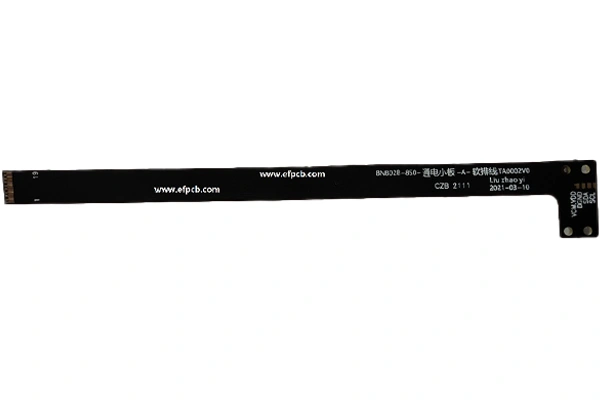
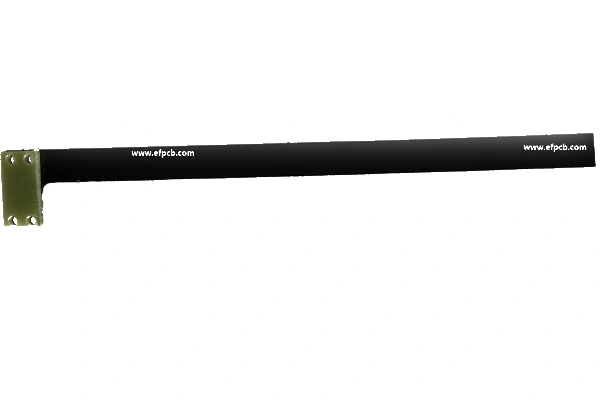
Part No.: E0215060199C
Layer count: 2 layer flexible PCB
Material: Polymide and FR5, 0.15mm,0.5 OZ for all layer
Minimum trace: 8 mil
Minimum space: 5 mil
Minimum hole: 0.20mm
Surface finished: immersion gold
Panel size: 138*28mm/1up
Flexible PCBs, also known as flexible printed circuit boards, have become fundamental elements of contemporary electronics, providing flexibility and durability that rigid boards can’t match. Services of flexible PCB manufacturer have witnessed rapid growth in demand as a result of their use in smartphones, medical devices, automotive electronics and wearable technology. The following is an analysis of the production process in full detail, which also examine the professionalism a flexible PCB manufacturer need to have in order to produce qualified products.
Overview of Production Process
The process of making flex circuit boards is complex and each stage must be completed with precision. A flexible PCB producer makes a start with substrate selection, which usually is polyimide or polyester films for outstanding flexibility and thermal stability. To promote bonding of subsequent layers, the substrate is cleaned and conditioned. Next comes the copper cladding, which is the application of a thin layer of copper onto the flexible substrate. This designs the conductive tracks for the electronic signals. A flexible PCB manufacturer covers the photoresist with a photoresist and then defines the circuit pattern using photolithography. UV light exposure through a mask bakes the desired areas, then the non-desired copper is etched away leaving the circuit traces.
Advanced Layering and Drilling
For flexible multi-layer PCBs, the producer laminates a number of the layers of substrate material and copper with the use of adhesives. Precision is needed for the integrity of the circuit. Laser or mechanical drilling is done to make holes, referred to as vias, which are used for electrical contacts between layers. The flexible PCB production process is processed with high precision, and the manufacturer uses the latest technology to produce holes which are clean and accurate without breaking the flexibility of the board.
Surface Finishing and Quality Control
Since the circuit is already formed, surface finishing is used for protecting the exposed copper from corrosion and for enhancing the solderability. Typical finishes are ENIG (Electroless Nickel Immersion Gold) and OSP (Organic Solderability Preservative). Rigid-Flex PCB Manufacturer The manufacturer of Rigid-Flex PCB who has high quality standards will never leave anything to chance and will have stringent levels of quality control at every point.
Final Assembly and Shipping
Then the flexible PCBs are boned to be assembled with other parts such as films or circuits. The flexible circuit producer knows that it is essential to maintain the flexibility of the product.
The knowledge of flexible PCB manufacturer is keenly felt in every part of its production, from the selection of the materials to the final inspection. By developing advanced processing methods and achieving high-quality standards, the flexible PCB manufacturer is essential to the advancement of present-day electronics. Their passion for innovation and reliability means the future will continue to be shaped by the electronics enabled by their flexible PCBs.